
✅ Company Creation in Tallyprime
Company Creation is the first and most important step in Tally Prime.
A Company in Tally represents a business entity for which accounting records are maintained.
Once a company is created, you can record:
- Accounting transactions
- Inventory records
- Payroll
- Statutory compliance such as GST, TDS, TCS, VAT, Excise
- Generate financial reports like Balance Sheet, P&L, Trial Balance
# Creating a company in Tally means opening a new set of books of accounts for a business for a particular financial year.
✅ Company Creation Fields
Company Creation Fields – Explanation
1. Directory
The Directory field specifies the data path (location) where the company data will be stored on the computer.
Explanation:
- By default, Tally creates the company in its default data folder.
- This field is skipped automatically if you accept the default location.
- To change the location, press the Backspace key and enter the required path.
Example:
D:\TallyPrimeData
2. Company Name
Enter the name of the company whose books of accounts are being created.
Explanation:
- If you are a professional accountant, always enter the client’s company name, not your own firm name.
Example:
ABC Traders Pvt. Ltd.
3. Mailing Name and Address
The Mailing Name is the name that appears on:
- Invoices
- Reports
- Letters
Explanation:
- By default, Tally displays the Company Name as the Mailing Name.
- You can change it if the mailing name is different from the company name.
Example:
- Company Name: ABC Traders Pvt. Ltd.
- Mailing Name: ABC Traders
4 State & Country
This information is used for tax calculation and statutory compliance (such as GST).
Explanation:
- Select the State and Country from the predefined list in Tally.
Example: State: Karnataka
Country: India
5. PIN Code:
PIN Code (Postal Index Number) of the company’s address.
Example: 585105
6 Telephone Number:
Enter the landline telephone number of the company (if available).
Example: 08472-123456
7 Mobile Number
Enter the mobile number of the company used for communication.
Example: +91 98765 43210
8 E-mail Address:
This e-mail address is used to:
- Send invoices
- Email reports
- Share GST returns directly from Tally
Example:
abctraders@gmail.com
9 Financial Year
A Financial Year is a fixed accounting period, usually 12 months, for which accounts are maintained.
Explanation:
- In most countries, accounts are maintained for 12 months.
- In India, the financial year starts on 1st April and ends on 31st March.
Example:
Financial Year From: 01-04-2024
Financial Year To: 31-03-2025
10 Books Beginning From
This field specifies the actual date from which accounting entries will start.
Explanation:
- By default, it is the same as the Financial Year From date.
- It can be changed if the business started later.
Example:
Business started on 01-06-2024
→ Books Beginning From: 01-06-2024
Security (TallyVault Password)
TallyVault is a security feature that encrypts company data using a password.
Important Note: ⚠️
- Use this feature very carefully.
- If the password is forgotten, data cannot be recovered.
- You may permanently lose the company data.
Example:
Set TallyVault Password only for highly confidential company data.
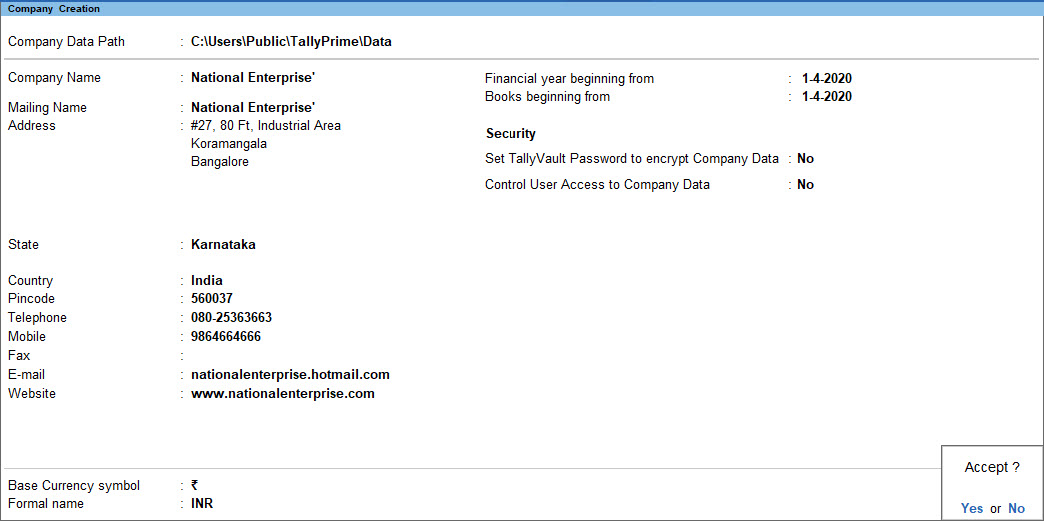
✅ Base Currency Setting Information
1 Base Currency Symbol
The symbol used to represent the main currency of the company.
Default Setting:
₹ (Rupees) Example: ₹ 5,000
2. Formal Name
The full official name of the currency represented by the symbol.
Default Setting:
Indian Rupees (INR)
Example: Symbol: ₹ Formal Name: Indian Rupees
3. Number of Decimal Places
The number of digits allowed after the decimal point in currency values.
Default Setting: 2 decimal places
Explanation:
- Indian currency uses 2 decimal places (Paise).
- Some foreign currencies may use 3 or 4 decimal places.
Examples:
- ₹ 150.75 (2 decimal places)
- ₹ 150.755 (3 decimal places – for foreign currency)
- Is Symbol Suffixed to Amounts?
Determines whether the currency symbol appears after the amount.
Default Setting: No
Explanation:
In India, the currency symbol is placed before the amount.
Examples:
- Correct (India): ₹ 1,000
- Incorrect (India): 1,000₹
- Symbol for Decimal Portion
The name used for the decimal part of the currency.
Default Setting: Paise
Example:
₹ 50.25 , → 25 Paise
- Show Amounts in Millions?
Displays large amounts in millions instead of full figures.
Default Setting: No
Examples:
- No: ₹ 1,00,00,000
- Yes: ₹ 10.00 Million (Generally kept No in Indian accounting)
- Put a Space Between Amount and Symbol?
Determines whether there is a space between the currency symbol and amount.
Default Setting: Yes
Examples:
- With space: ₹ 500
- Without space: ₹500
- Decimal Places for Printing Amounts in Words
Specifies how many decimal places should be printed when the amount is shown in words.
Important Rule:
This number must be equal to or less than the number set in Number of Decimal Places.
Examples:
- Amount: ₹ 125.50
- Printed in words:
Rupees One Hundred Twenty-Five and Fifty Paise Only - If decimal places = 0
₹ 125.00 , → Rupees One Hundred Twenty-Five Only